
Election Integrity Facts
Sorting fact from fiction can be difficult when it comes to claims about election integrity, voting rights, and legal issues affecting our electoral system. Still, defending the Rule of Law in America depends on protecting our free and fair elections, including the right for all eligible voters to cast their ballot and have their vote duly counted. Global experience shows that disinformation questioning election integrity weakens democratic participation and trust in democratic, Rule of Law systems more generally.
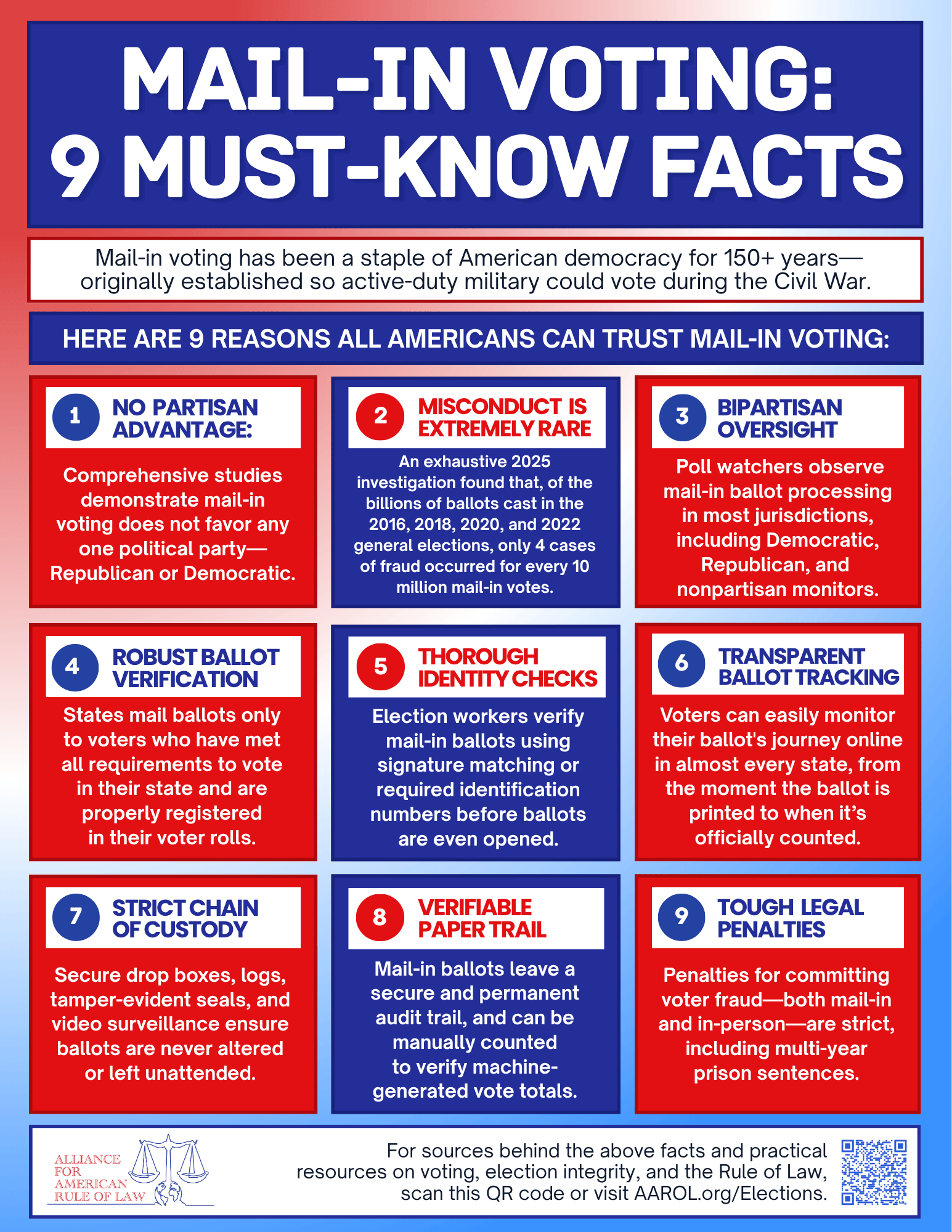
To help dispel mis- and disinformation surrounding our elections, AAROL has developed this three-part Election Disinformation Must-Know Facts series debunking common myths about election fraud, mail-in voting, and election interference. These graphics are designed to be accurate, nonpartisan, and shareable with all audiences, not just lawyers.
We encourage you to read and download the graphics, and think about how you can share this information with your community! Consider posting the graphics on social media while you encourage others to register to vote, or printing them for distribution or posting at your next community event. Click the images or the links above to download sharable image files. PDF versions with links to the sources are also available below.
Be sure to also follow the Alliance for American Rule of Law on LinkedIn and Instagram, where we share these and other resources supporting elections, voting, and the Rule of Law.

#1: Thompson, D.M, Wu, J.A., Yoder, J., & Hall, A.B., (2020). “Universal vote-by-mail has no impact on partisan turnout or vote share,” Proceedings of the National Academy of Science, 117 (25) 14052-14056. doi.org/10.1073/pnas.2007249117.
#2: Angel, S., Katz, J., & Wright, R. (2025). “Mail voting in the US: Data points to very low fraud and significant benefits to voters,” Brookings, brookings.edu/articles/mail-voting-in-the-us-data-points-to-very-low-fraud-and-significant-benefits-to-voters.
#3: Center for Election Innovation and Research (2026). “CEIR Explains: What Happens After We Vote,” electioninnovation.org/research/what-happens-after-we-vote/; National Conference of State Legislatures (2025). “Poll Watchers and Challengers,” ncsl.org/elections-and-campaigns/poll-watchers-and-challengers.
#4: Bipartisan Policy Center (2026). “Mail-in Voting is Safe and Secure,” bipartisanpolicy.org/report/mail-voting-is-safe-secure.
#5: Center for Election Innovation and Research (2026). “CEIR Explains: How a Ballot Becomes a Vote,” electioninnovation.org/research/how-a-ballot-becomes-a-vote.
#6: Vote.org, vote.org/ballot-tracker-tools/; U.S. Vote Foundation, usvotefoundation.org/wheres-my-ballot.
#7: Weiser, R. & Ekeh, H. (2020). “The False Narrative of Vote-by-Mail Fraud,” Brennan Center for Justice, brennancenter.org/our-work/analysis-opinion/false-narrative-vote-mail-fraud; Bennan Center for Justice (2024). “Mail Ballot Security,” brennancenter.org/our-work/research-reports/mail-ballot-security.
#8: Center for Election Innovation and Research (2026). “CEIR Explains: What Happens After We Vote,” electioninnovation.org/research/what-happens-after-we-vote.
#9: Weiser, R. & Ekeh, H. (2020). “The False Narrative of Vote-by-Mail Fraud,” Brennan Center for Justice, brennancenter.org/our-work/analysis-opinion/false-narrative-vote-mail-fraud.
#1: Kamarck, E. (2024). “How widespread is election fraud in the United States? Not very,” Brookings, brookings.edu/articles/how-widespread-is-election-fraud-in-the-united-states-not-very.
#2: Heritage Foundation Election Fraud Map data, electionfraud.heritage.org; Kamarck, E. (2024). “How widespread is election fraud in the United States? Not very,” Brookings, brookings.edu/articles/how-widespread-is-election-fraud-in-the-united-states-not-very.
#3: Angel, S., Katz, J., & Wright, R. (2025). “Mail voting in the US: Data points to very low fraud and significant benefits to voters,” Brookings, brookings.edu/articles/mail-voting-in-the-us-data-points-to-very-low-fraud-and-significant-benefits-to-voters.
#4: Cassidy, C. (2021). “Far too little vote fraud to tip election to Trump, AP finds,” Associated Press, apnews.com/article/voter-fraud-election-2020-joe-biden-donald-trump-7fcb6f134e528fee8237c7601db3328f.
#5: Fair Elections Center. (2026). “Voting by Non-Citizens is a Non-Issue: Data From All Sources Shows That Overwhelmingly, Only U.S. Citizens Are Voting,” fairelectionscenter.org/voting-by-noncitizens-is-a-non-issue.
#6: Center for Election Innovation and Research (2026). “Claims of Noncitizen Registration or Voting: Analysis and Tracker,” electioninnovation.org/research/claims-noncitizen-registration-voting-analysis-tracker/
COMING SOON: Must-Know Facts on Election Interference